Every megawatt of IT load in a data centre generates heat. Managing that heat is the single largest operating cost a data centre operator faces, typically 30-40% of total energy consumption. At the centre of every cooling system, whether you are running CRAC units, in-row coolers, or hot/cold aisle containment, is an array of axial fans moving air through the facility.
Selecting the wrong fan, whether wrong size, wrong motor technology, or wrong operating point, costs money every hour the data centre is running. Selecting the right fan array, engineered to your specific airflow and static pressure requirements, is one of the most impactful infrastructure decisions you can make.
This article focuses specifically on fan arrays for data centre cooling: what they are, how to engineer them correctly, which motor technologies deliver the best efficiency, and how trumaxx fan products are designed to meet the demands of modern Indian data centres.
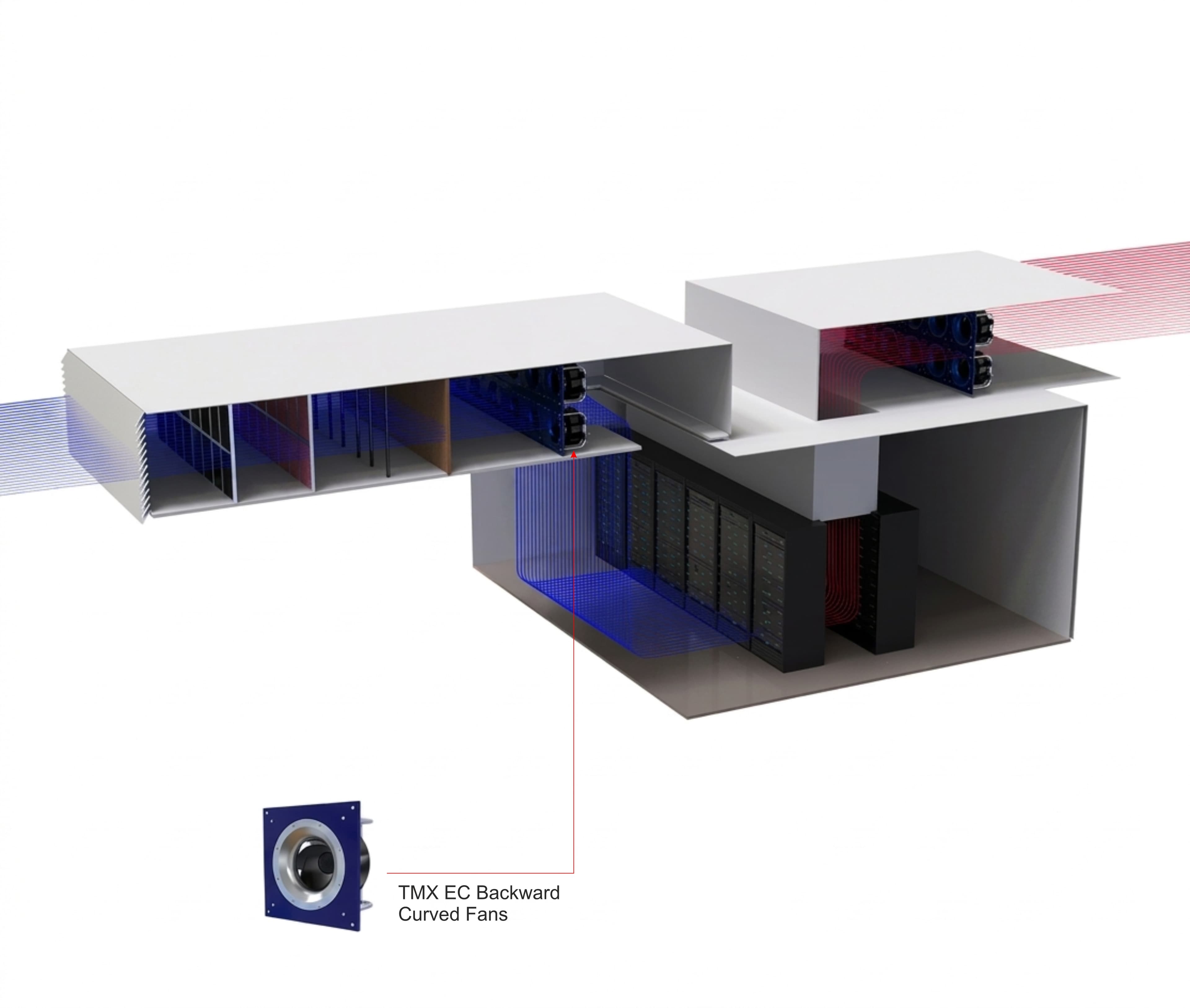
A fan array is a configuration of multiple fans arranged in a parallel or series grid within a single air-handling unit, CRAC unit, or plenum. Instead of relying on one large, high-capacity fan, a fan array distributes airflow across several smaller fans operating simultaneously.
| Parameter | Single Large Fan | Fan Array (Multiple Fans) |
|---|---|---|
| Redundancy | Single point of failure | N+1 redundancy built in |
| Efficiency at part load | Poor; fan laws punish oversized fans | Excellent; modulate individual fans |
| Noise | High at full load | Distributed, lower per-fan dB |
| Maintenance | Full shutdown required | Hot-swap individual fans |
| Scalability | Replace entire unit | Add fans as IT load grows |
The fan laws, specifically the cube law for power, mean that running six fans at 70% speed uses dramatically less energy than running six fans at 100%. A fan array with variable speed control can match airflow exactly to real-time IT load, which is where the efficiency gains compound.
trumaxx manufactures three motor technology variants relevant to data centre fan arrays. Understanding the differences is essential before specifying any cooling infrastructure.
Electronically Commutated motor technology combines the power supply flexibility of AC with the efficiency and speed control of DC. The result is a brushless, externally rotor motor with integrated electronics that achieves motor efficiencies above 90%, compared to 55-70% for standard AC induction motors.
trumaxx EC Axial Fans, including models TMX-EC72-A350, TMX-EC92-A400, and TMX-EC102-A450, are engineered specifically for applications where energy efficiency, precise speed control, and long operational life are critical. These are the characteristics data centre operators demand.
Key EC Axial Fan advantages for data centre fan arrays:
For a data centre targeting PUE below 1.4, EC axial fans in the cooling arrays are not optional. They are an engineering necessity.
trumaxx AC Axial Fans, SAFE series from 200 mm to 800 mm diameter, are the industry-proven solution for applications with fixed or limited speed requirements. They are available in single-phase suffix E and three-phase suffix D, with 2-pole, 4-pole, and 6-pole configurations covering a wide range of airflow and static pressure requirements.
| Model | Voltage (V) | Power (W) | Speed (RPM) | Air Volume (CMH) |
|---|---|---|---|---|
| YWF4E-400 | 220 | 180 | 1,380 | 3,980 |
| YWF4E-500 | 220 | 420 | 1,300 | 7,155 |
| YWF4E-600 | 220 | 700 | 1,360 | 10,050 |
| YWF4D-600 | 380 | 780 | 1,350 | 10,230 |
| YWF4E-630 | 220 | 750 | 1,360 | 12,400 |
Where AC axial fans are the right choice in data centres:
Three-phase variants, suffix D, offer smoother torque and better efficiency at larger sizes. They are the preferred choice for fans above 400 mm in commercial data centre deployments.
trumaxx EC Compact Cooling Fans, including models TRU-EC12038-M and TRU-EC12038-H, address a different but equally critical layer of the data centre cooling architecture: the rack and enclosure level.
While CRAC units and in-row coolers manage room-level airflow, compact fans manage airflow at the panel, enclosure, and equipment level. EC compact fans bring the same variable speed, brushless efficiency advantages to smaller form factors, essential for cooling power distribution units, patch panels, and network enclosures within the data hall.
Specifying a fan array for a data centre cooling system requires matching fan performance to the thermal load and the physical constraints of the air path. These are the four parameters that determine whether an array will perform as designed.
The required airflow is calculated from the IT load and the desired temperature rise across the cooling unit. For a typical data centre temperature rise of 15°C, every 100 kW of IT load requires approximately 20,000 CMH of airflow.
Q (CMH) = P (kW) × 3,600 / (ρ × Cp × ΔT)

ρ = air density, approximately 1.2 kg/m³
Cp = specific heat of air, 1.006 kJ/kg·K
trumaxx AC axial fans cover outputs from 380 CMH in 200 mm models to over 12,000 CMH in 630 mm models. An array of 4 x YWF4E-500 fans delivers approximately 28,600 CMH, sufficient for a 140 kW IT load at 15°C temperature rise.
Data centres are not open-air environments. Air must be forced through filters, coils, hot aisle containment structures, and raised floor plenum perforations. Each element adds resistance, measured in Pascals.
A poorly sized fan array that meets airflow targets at zero static pressure will deliver significantly less airflow when installed in a real system with 50-150 Pa of resistance. The fan curve intersection with the system resistance curve determines the actual operating point.
trumaxx fans are rated at operating static pressures, not free-air conditions. Specifying at the correct operating point is critical, and trumaxx can support system curve matching.
Data centre sound levels are regulated in many facilities, particularly colocation environments with on-site personnel. High-speed 2-pole fans generate significantly more noise than slower 4-pole and 6-pole variants. Fan arrays of multiple slower fans running at moderate speed consistently achieve lower noise floors than single-fan equivalents running at high speed.
Fan array redundancy is defined by the minimum number of fans required to maintain cooling at maximum IT load. An N+1 array has one fan more than the minimum; N+2 has two. The array must be engineered so that the loss of any single fan does not cause thermal runaway.
Hot-swap fan modules, where individual fans can be replaced without system shutdown, are standard in trumaxx array-compatible configurations. This directly supports Tier III and Tier IV data centre uptime requirements.
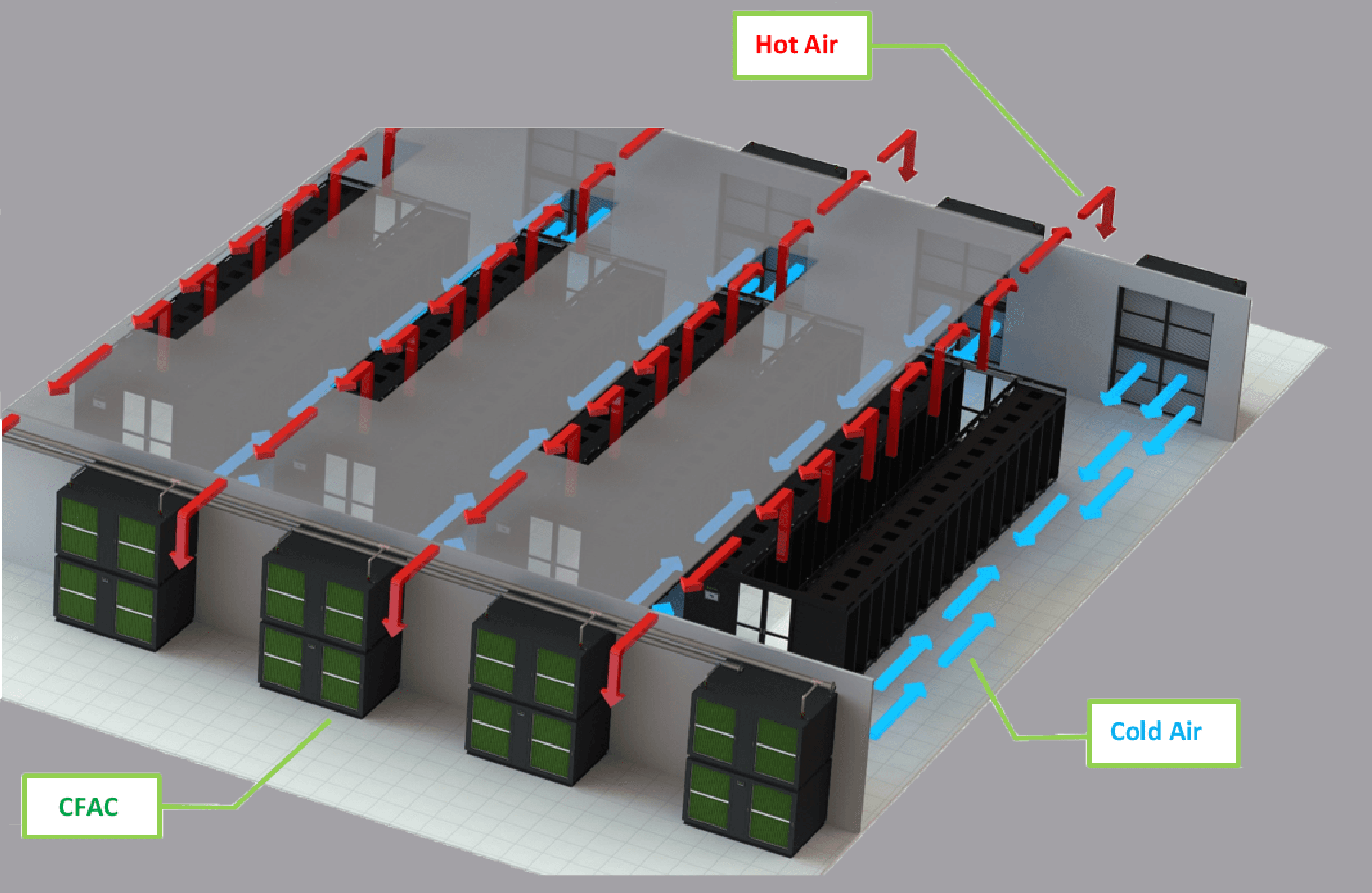
Computer Room Air Conditioning and Computer Room Air Handling units are the backbone of raised-floor data centre cooling. Legacy CRAC units typically use single PSC or permanent split capacitor AC fans with no speed control. Replacing these with EC axial fan arrays delivers major operating improvements.
In-row coolers sit between server racks, cooling air at the point of generation. Fan array design for in-row applications prioritises compact footprint, high static pressure capability, and very low noise, all parameters where trumaxx EC axial fans excel over AC alternatives.
Hot aisle containment systems capture exhaust air from the rear of server racks and channel it to overhead cooling units. Fan arrays in ceiling plenums must generate sufficient negative pressure to overcome the buoyancy of hot air rising in the containment zone. This is a high static pressure, moderate airflow application, typically served well by 4-pole and 6-pole trumaxx axial fans in the 400-600 mm range.
Indian data centres with favourable ambient conditions are increasingly deploying adiabatic or dry cooler economisers to reduce mechanical refrigeration hours. The outdoor heat rejection fans in these systems run continuously, often in harsh environments with dust, humidity, and temperature extremes.
trumaxx AC axial fans are rated for industrial environments. Three-phase models with IP54 ratings are the standard specification for outdoor economiser applications. The DC and EC variants add speed control capability for economiser systems that modulate fan speed based on ambient wet-bulb temperature.
India's data centre capacity is growing at over 20% CAGR, driven by cloud adoption, the Digital India initiative, and the rapid onboarding of AI workloads. The Bureau of Energy Efficiency has introduced the Data Centre Energy Conservation Award and is actively developing mandatory energy efficiency standards for data centres.
Indian data centres face a specific challenge that European and North American operators do not: high ambient temperatures, dust, and humidity year-round. A Mumbai or Chennai data centre cannot rely on free cooling for more than a few hundred hours per year. Mechanical cooling, and therefore fan array efficiency, matters more in the Indian context.
Key considerations for Indian data centre fan arrays:
Every trumaxx fan destined for critical infrastructure applications passes through a rigorous quality validation process. For data centre operators, these tests directly map to uptime and performance guarantees.
| Test | What It Validates |
|---|---|
| Air Flow Test | Confirms actual CMH output matches datasheet specification at rated voltage and speed |
| Run Test | Extended operation under load to confirm thermal stability and bearing performance |
| Hipot Test | High-potential electrical insulation test, critical for safety in IT environments |
| IP Test (Water & Dust) | Verifies ingress protection rating under IEC 60529 test conditions |
| Transport Simulation Test | Ensures products survive shipping and installation without latent damage |
| Real Time Life Cycle Test | Long-duration validation of actual operational lifespan |
For data centre operators under SLA pressure, buying fans that have passed this test suite is not a luxury. It is risk management.
Data centre cooling efficiency starts with a clear understanding of the airflow requirement, the system resistance curve, the redundancy target, and the motor technology best suited to the operating profile. Fan arrays built on EC axial fans deliver the best combination of efficiency, control, and reliability for modern data centres. AC axial fans remain the right choice for specific applications where cost, simplicity, or fixed-speed operation dominates the selection criteria.
trumaxx has been engineering axial fans for HVAC&R applications since 2010, with a product range spanning 200 mm to 800 mm, AC through EC motor technologies, and single-phase through three-phase electrical configurations. The same engineering precision, rigorous quality testing, and pan-India availability that serves the HVAC&R industry is now directly applicable to India's growing data centre sector.
EC, or Electronically Commutated, fans use brushless motors with integrated speed control electronics, achieving 85-92% motor efficiency across their operating range. AC fans use standard induction motors, typically 55-70% efficient, and require external VFDs for speed control. For data centre applications where fans run continuously, EC fans offer substantially lower total cost of ownership despite higher upfront cost.
At 1 MW IT load with a 15°C temperature rise across the cooling units, the total required airflow is approximately 200,000 CMH. A redundant N+1 fan array using trumaxx YWF4E-630 fans, approximately 12,400 CMH each, would require a minimum of 17 fans, with 18-20 fans in an N+1 or N+2 configuration. Contact trumaxx for a system-specific sizing calculation.
Yes. trumaxx EC Axial Fans support 0-10V and PWM speed control signals, the two standard interfaces used by Building Management Systems and Data Centre Infrastructure Management platforms. This enables automated fan speed modulation based on real-time IT load, ambient temperature, and cooling unit inlet and outlet temperatures.
trumaxx EC Axial Fans use brushless motors with no physical commutator wear. Ball bearing models are rated for 80,000+ hours MTBF under standard operating conditions. This exceeds the 40,000-hour target lifespan of most data centre cooling infrastructure refresh cycles.
Yes. Three-phase AC axial fans with IP54 ratings are the standard trumaxx specification for outdoor heat rejection applications. EC variants with weather-resistant housings are available for applications requiring variable speed outdoor operation.
At trumaxx, we help data centre operators, OEMs, and HVAC&R system designers select fan arrays based on airflow, static pressure, redundancy, motor technology, noise, and real operating conditions.
Get in touch with trumaxxCopyright © 2024 Safe Refrigerations (P) Ltd. | Privacy Policy | Terms & Condition