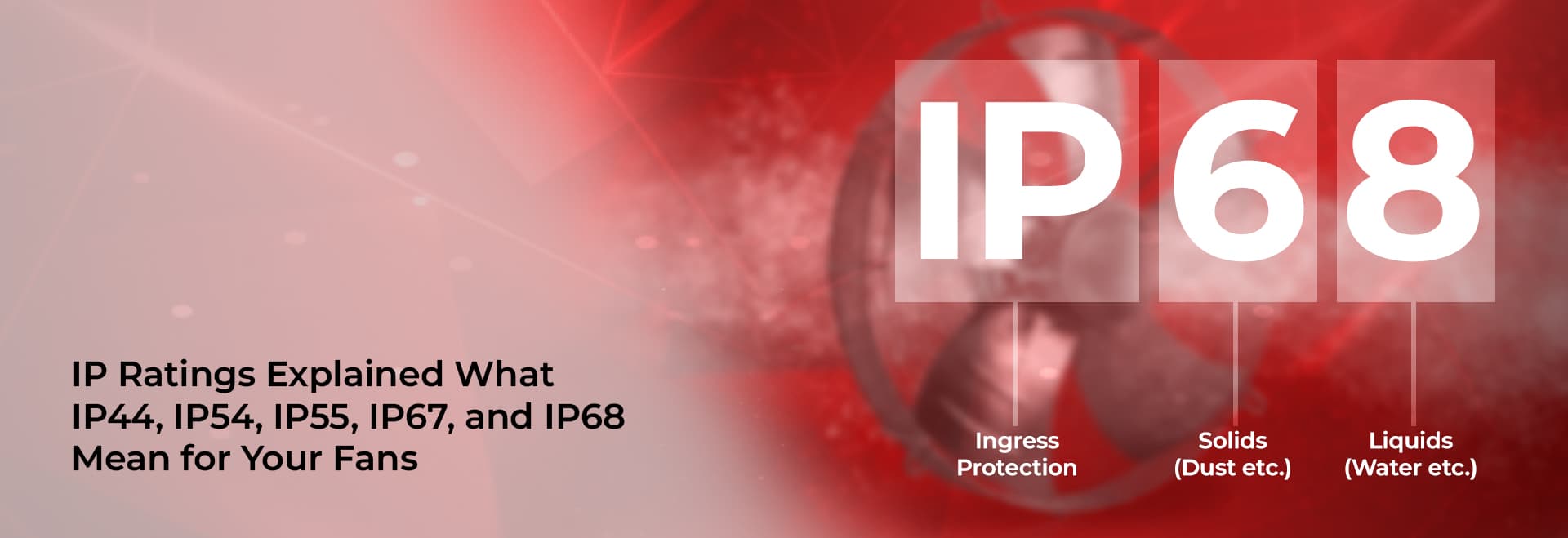
You've shortlisted an axial fan for your outdoor condenser unit. The datasheet shows an IP rating: IP54, maybe IP55. But what does that actually mean in practice? Will it survive a monsoon season on a rooftop in Chennai? Will dust from a nearby construction site clog the motor in six months?
These are exactly the questions an IP rating is designed to answer, if you know how to read it.
This guide breaks down IP ratings in plain terms: how the system works, what each level protects against, and which rating you actually need for your application.
IP stands for Ingress Protection. It is an international standard, IEC 60529, that classifies the degree of protection an electrical enclosure, like a fan motor housing, provides against solid particles such as dust and liquids such as water.
Every IP rating consists of two digits:
IP [X] [Y]

X = Dust / solid protection level (0-6)
Y = Water protection level (0-8)
The higher the digit, the greater the protection. Two numbers. Once you understand the scale for each digit, reading any IP rating takes about five seconds.
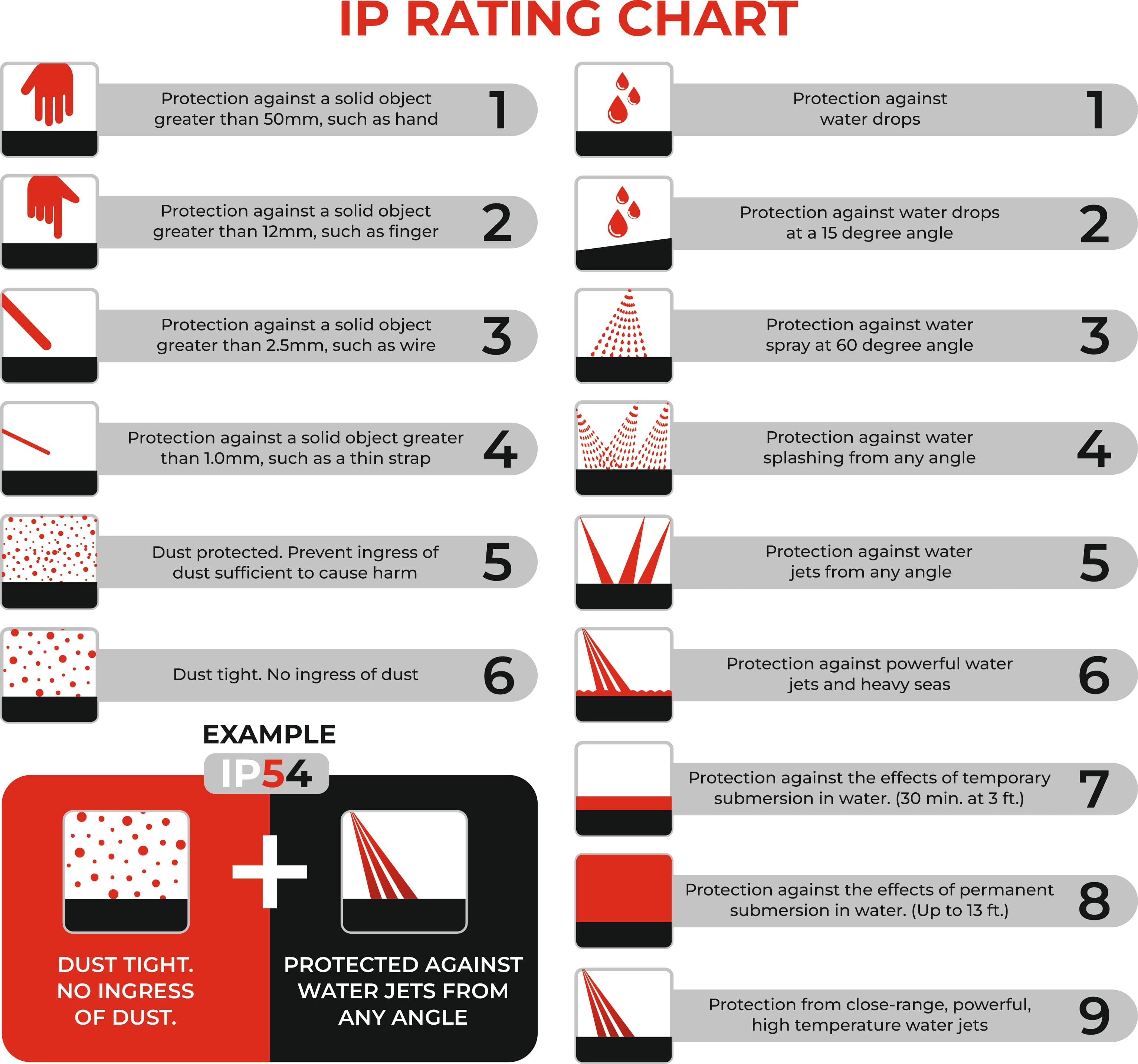
| First Digit | Protection Level | What It Means |
|---|---|---|
| 0 | None | No protection |
| 1 | >50 mm | Large body parts only |
| 2 | >12.5 mm | Fingers and similar objects |
| 3 | >2.5 mm | Tools and thick wires |
| 4 | >1 mm | Most wires, small screws |
| 5 | Dust protected | Limited dust ingress; not harmful to operation |
| 6 | Dust tight | Zero dust ingress; fully sealed |
For fan applications, digit 4 means small particles of 1 mm and above are blocked, which is adequate for clean indoor environments. Digit 5 means dust can enter but not in quantities that would damage the motor, making it suitable for most outdoor and industrial sites. Digit 6 is a full seal, critical in heavily contaminated environments like cement plants, grain facilities, or any setting with fine airborne particulate.
| Second Digit | Protection Level | What It Means |
|---|---|---|
| 0 | None | No protection |
| 1 | Dripping water | Vertical drips only |
| 2 | Dripping at 15° tilt | Slight angle, vertical drips |
| 3 | Spraying water | Water sprayed up to 60° from vertical |
| 4 | Splashing water | Water splashing from any direction |
| 5 | Water jets | Low-pressure water jets from any direction |
| 6 | Powerful water jets | High-pressure water jets |
| 7 | Immersion up to 1 m | Temporary submersion up to 30 minutes |
| 8 | Immersion beyond 1 m | Continuous submersion at specified depth |
Digit 4 protects against splashing, such as rain, cleaning spray, or ambient moisture in a refrigeration room. Digit 5 handles directed low-pressure jets, so a hose-down during maintenance will not damage the motor. Digit 7 means the fan can survive brief submersion, which is relevant in drainage pump areas, flood-prone outdoor installations, or certain EV applications where coolant leakage is a risk. Digit 8, or IP68, means continuous immersion beyond 1 metre, the highest level of water protection.
Reads as: protected against solids greater than 1 mm and protected against water splashing from any direction.
Suited for enclosed indoor environments with moderate humidity, including refrigeration display cases, fan coil units, indoor AHUs, and server room cooling where splash risk is minimal.
Not suited for direct outdoor exposure, dusty worksites, or washdown environments. IP44 offers basic protection, but it is not a monsoon-proof rating.
Reads as: dust protected, meaning limited ingress that is not harmful, and protected against water splashing from any direction.
Suited for outdoor condensing units, rooftop HVAC installations, light industrial settings, and parking garage ventilation. This is one of the most common ratings in the HVAC&R industry.
The combination of dust protection and omnidirectional splash resistance handles the reality of most Indian outdoor environments: intermittent rain, ambient dust, and the occasional accidental water contact during maintenance.
Limitation: IP54 is not a high-pressure washdown rating. In applications where equipment is routinely hosed down or is near high-pressure water sources, you want IP55 or higher.
Reads as: dust protected, meaning limited ingress that is not harmful, and protected against low-pressure water jets from any direction.
Suited for cooling towers, outdoor heat exchangers, marine environments, industrial facilities with periodic washdown, and coastal HVAC installations exposed to salt-laden air and rain.
The practical difference from IP54 is that IP55 can handle a direct stream of water, such as a maintenance hose, heavy driving rain at an angle, or coolant spray in a mechanical room. This matters in field service. If a technician routinely cleans fans in place, IP55 is a significantly safer choice than IP54.
Reads as: dust tight, meaning zero ingress, and protected against temporary immersion up to 1 metre for 30 minutes.
Suited for outdoor EV battery systems, drainage and pump areas, aggressive industrial environments, and applications in high-humidity tropical climates where condensation and water accumulation are constant risks.
In Electric Vehicle battery thermal management systems, fans operate in sealed battery enclosures where any moisture ingress or fine conductive dust can cause short circuits, thermal runaway, or corrosion over the vehicle's lifetime. IP67 eliminates that risk. For EV buses and commercial EVs operating in Indian road conditions, including dust, monsoon flooding, and road spray, IP67 is not a premium specification; it is the baseline requirement.
| Rating | Dust Protection | Water Protection | Typical Application |
|---|---|---|---|
| IP44 | Solids >1 mm blocked | Splashing from any direction | Indoor HVAC, refrigeration |
| IP54 | Dust limited, not harmful | Splashing from any direction | Outdoor condensers, rooftop HVAC |
| IP55 | Dust limited, not harmful | Low-pressure jets from any direction | Cooling towers, coastal sites, industrial |
| IP67 | Fully dust tight | Immersion up to 1 m / 30 min | EV BTMS, drainage, aggressive industrial |
| IP68 | Fully dust tight | Continuous immersion beyond 1 m | EV BTMS, extreme outdoor; trumaxx DC fans |
trumaxx DC Axial Fans, both the SAFE-LNF brushed series and SAFE-WSLNF brushless series, are rated IP68: the highest standard ingress protection rating, offering complete dust-tight sealing and protection against continuous immersion beyond 1 metre depth.
These fans are specifically engineered for:
The DC brushless series eliminates brushes entirely, which removes one of the most common failure modes in dusty or humid environments. No brushes means no carbon debris, no mechanical wear at the contact point, and no arc-induced ignition risk in moisture-rich conditions.
With IP68, trumaxx DC fans exceed even the submersion depth of IP67, making them suitable for the harshest real-world EV and outdoor environments across India, from monsoon-prone coastal cities to dusty industrial corridors.
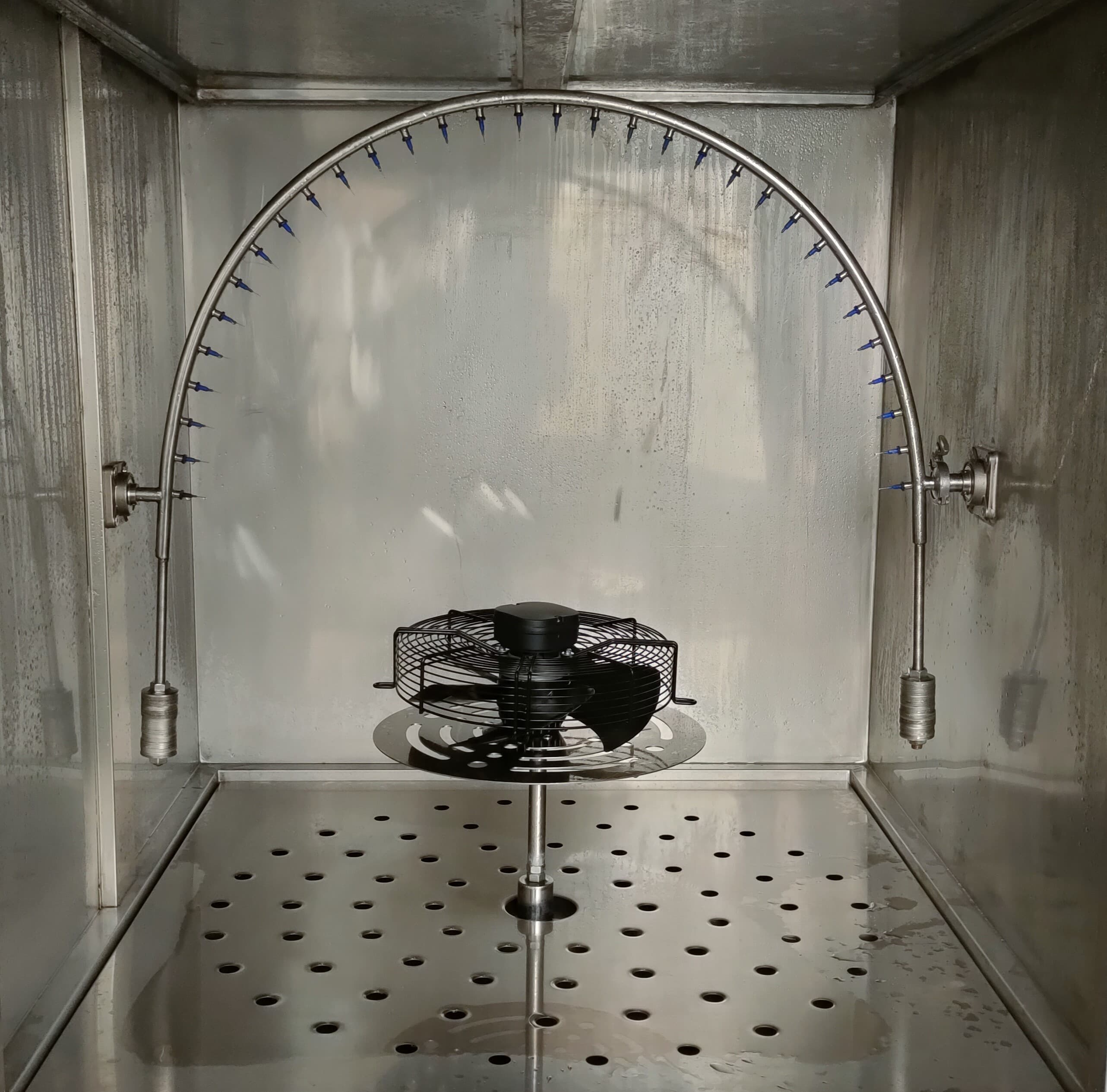
Every trumaxx fan goes through an in-house IP Test for water and dust as part of the standard quality assurance process before a unit ships. This is not a sample test on a few units per batch. It is part of the trumaxx testing protocol alongside hipot testing, run testing, and real-time life cycle testing.
If you are specifying fans for an EV or outdoor HVAC application and want to confirm the exact IP rating for a specific model, contact the trumaxx team. They will match the right fan to your ingress protection requirement.
Not always. Higher IP ratings typically mean more sealed enclosures, which can affect heat dissipation from the motor. For an indoor application with clean, dry air, specifying IP68 adds cost without benefit. Match the rating to the actual environment.
An X in either digit position means that specific protection has not been tested or rated. It does not mean there is no protection. For example, IPX4 means water protection is rated at level 4, but the dust protection level is unspecified.
No. IP ratings only address solid particles and water. If your environment involves oil mist, corrosive chemicals, or refrigerant exposure, check the manufacturer's specification separately.
Yes. Protection levels are cumulative within each digit. A fan rated IP55 also withstands everything IP54 covers. IP68 provides more water protection than IP67, but you should confirm exact submersion depth and duration with the manufacturer for your application.
Reputable manufacturers test to IEC 60529 and can provide test reports. trumaxx conducts IP tests in-house as part of standard quality validation. When specifying fans for critical applications, ask for test documentation rather than relying on a printed datasheet number alone.
At minimum, IP54. For coastal locations, heavy industrial areas, or sites with periodic washdown, IP55 is the safer choice. For EV battery systems or any application where submersion or continuous moisture exposure is possible, trumaxx DC fans at IP68 are the right specification.
At trumaxx, we help OEMs and system designers select fans based on real installation conditions, including dust exposure, washdown risk, outdoor placement, EV battery requirements, and long-term reliability targets.
Get in touch with trumaxxCopyright © 2024 Safe Refrigerations (P) Ltd. | Privacy Policy | Terms & Condition